


 |
Contact (H) 602.996.3798
(C) 480.748.3715
U.S. Air Force Auxiliary
|
 |
NEW MEETING PLACE
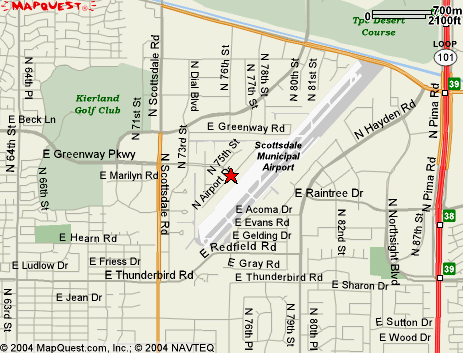
Squadron 314 meets on the second and fourth Monday of the month at 7:00 PM for the official meeting, in the Second Floor Conference Room of the new Aviation Business Center located at the Scottsdale Airport. The address is 15000 North Airport Drive. Scottsdale AZ 85260. Visitors are welcome.
What is Civil Air Patrol
Civil Air Patrol is the civilian auxiliary of the United States Air Force and is comprised of volunteer members.
What do they do?
CAP has three main functions: Emergency Services (comprised of air and ground search and rescue and disaster relief), Aerospace Education, and the Cadet Program.
How much does it cost to join?
Dues per year are $63.00 (National CAP), and $50.00 (Squadron).
You will also need to have your fingerprints taken. This can be done for a charge of about S5.00 to $8.00 at any local Police Department or you can have it done at a commercial fingerprinting company, usually for a nominal fee.
Do I have to be a pilot?
No. There are numerous areas for service, including communications, administration, ground teams and other positions. Non-pilots who still wish to fly, participate as scanners/observers, very necessary positions.
What is expected of me?
There are five levels of training in the CAP. Each of these levels has requirements that must be completed in order to advance and to receive promotions in rank. You must complete the Level I training within 6 months after joining. This is comprised of a series of on-line courses that will introduce you to the history and background of CAP, the Cadet Protection Program Course, Operations Security, and Equal Opportunity. These on-line modules are followed by a Summary Conversation with the Squadron Commander to ensure that you understand the material. The full instructions for completing Level I can be found at the following link:
http://members.gocivilairpatrol.com/cap_university/level-1-orientation/
After completion of Level I you may participate in CAP activities such as training classes and courses. If you are interested in flying, the squadron periodically offers classes in Scanner, Observer, and Mission Pilot.
There are many additional requirements that you will need to complete such as radio operations and FEMA Management courses.
What do I get out of it?
Besides the great satisfaction of serving your community and country, there are numerous benefits to belonging to CAP. Education and training are only a part of it. Classes are held in CPR, first aid, leadership and management techniques, as well as specialized classes in CAP-specific areas such as mission coordination and ground search and rescue. A variety of correspondence courses are also available through the US Air Force correspondence courses.
Each year there is a Wing Conference within the state, and a National Conference is held at a different location within the country annually.
"Field trips" in the past have included KC135 refueling rides; hands-on experiences in the F15/16 simulators at Luke AFB, as well as squadron level visits to interesting sites locally.
The squadron has a Cessna 206H Turbo aircraft taht is available to qualified CAP pilots for proficiency flight time, subject to certain restrictions, at a much lower rate than for a comparable aircraft at an FBO.
There are several publications you will receive: "Volunteer", the national news magazine, "Wing Tips", the Wing quarterly on line magazine; and "Blacksheep” News ' N Notes", the monthly on line squadron newsletter.
Although you will probably make some great friendships and experience some great experiences through Civil Air Patrol, it IS NOT a social or flying club. CAP is a service organization accountable to the Air Force and other governmental agencies with which we have agreements. The members are ambitious, hard working, professional dedicated, and willing to say "yes" to as many opportunities as they can fit into their schedules.
As with any volunteer organization what you will get out of it is proportionate to what you're willing to put into it. However, we will guarantee that the formula is an exponential one, and you will be richly rewarded for becoming an active part of Civil Air Patrol!
SQUADRON 314 PROGRESSION CHECKLIST
1. To join CAP
-Fill out two original applications
- Print and fill the Unit Membership Questionaire <-- Click to open the pdf questionaire
- Meet with membership committee
- Get fingerprinted
- Submit applications, fingerprint card, and a yealry dues of $63.00 check to National Headquarters, Civil Air Patrol.
- You will be billed for Squadron 314 yearly dues of $50.00.
2. Initial Requirements
- Complete Level I modules on line. See the Professional Development Officer if you require assistance.
3. Emergency Services Training for MS (Mission Scanner)
- Meet with the Emergency Services Officer to enroll in a Mission Scanner Class. The requirements for MS are outlined in the SQTR (Specialty Qualification Training Records) contained in Ops Qual (Operations Qualifications) on eServices (the CAP online site). Once you complete the ground training class, you will become a MS Trainee and can begin training in aircraft.
- If possible, fly a Practice flight with a qualified pilot when he/she flies their proficiency time; or participate in a squadron exercise as a scanner trainee.
- When you complete requirements for Mission Scanner Trainee, your achievement will be posted to the Ops Qual section of eServices on a form known as the 101 (Emergency Services Qualifications) card.
4. Intermediate Training: Observer (MO)
- The training for Mission Observer is similar to MS. There is an SQTR for MO in Ops Qual. Your progress through trainee and fully qualified is posted in Ops Qual on the 101 card.
- Participate as possible in a squadron or wing exercises as a mission scanner or observer trainee, and/or as a mission scanner during an actual Redcap.
Training as a Mission Pilot
Basic Requirements: FAA pilot's license, current medical, CAP membership card, Level I and Cadet Protection, previous [FAA] checkout in a Cessna 206H Turbo ( minimum of 2 one hour flights ) or other high performance aircraft. MINIMUM PIC 100 HRS WITH 10 IN HIGH PERFORMANCE AIRCRAFT.
1. With the minimum requirements above, you can receive a Form 5 checkout in the corporate aircraft at any time after you have completed the Level I training. No mission training is required; however, you MUST attain at least a Scanner rating within 6 months of your Form 5 checkout to remain qualified to fly the plane.
Expect a minimum of 1-hour flight time with a CAP instructor prior to scheduling the checkride. Be familiar with the aircraft questionnaire and regulations covering CAP flight. (See squadron check pilot to obtain packet of information and form that will be required during checkout.) A Form 5 checkout merely assures that you meet minimum CAP standards to pilot the aircraft.
2. Be familiar with your responsibilities once you have received a Form 5, i.e. aircraft maintenance and fuel fees, required proficiency time, required squadron participation, approved flight uniforms, approved passengers, etc. If you have ANY questions, please ask!
3. With a minimum of 175 hours PIC and a scanner rating, you can be officially listed as Mission Pilot Trainee and fly as such during wing exercises.
4. With a minimum of 200 hours PIC and an observer rating, after flying at least three SAR exercises as pilot with an experienced mission pilot aboard for guidance. And upon satisfactory completion of the Form 91 Mission Pilot Checkride, you can receive a new 101 card indicating the Mission Pilot qualification. This rating is required to fly as PIC during actual Redcaps or any other official Wing mission.
Note: Flight training time for mission pilot is a minimum of 3 hours.
REQUIREMENTS FOR SPECIALIZED TRAINING
Any Mission Base Position (Administration, Communications, Flight Releasing, Briefing/Debriefing, Safety, etc.): Mission rating (General Emergency Services), obtain basic training through squadron positions, online courses, etc. and participate as trainee during wing exercises.
Ground Team : Mission rating (General Emergency Services), First Aid, ground team training through SQ, group, or wing.
Air Force Low Level flights: Mission pilot rating, 500 hours PIC, Commercial rating, and orientation flight as observer, be on Wing list (see Wing Chief Check Pilot).
DEA- Mission pilot rating , 500 hours PIC, Customs clearance form (Form 83) submitted and cleared, DEA sponsored class and be a member for a minimum of two years. Have CD notation on CAPF 101.
Customs : Mission rating (observer or pilot), be a member for a minimum of two years, customs clearance form filled out, submitted, and cleared by FBI and Customs, release form signed and submitted to wing, Customs class taught by Customs personnel, AZ CAP Customs class. Be on Wing list and have annotated CAPF 101. Maintain currency through participation.
Incident Commander: Experienced mission participants only. Obtain specialized training through Wing. Attend Incident Commander training.
.... UNIFORMS ----
CAP Uniforms and proper wearing of such can be found in the CAP Manual 35-1.
USAF type uniforms can be obtained from military surplus stores or from an online supplier called Vanguard.
Vanguard is the official Civil Air Patrol Store. It can be reached at:
http://www.vanguardmil.com/civil-air-patrol-c-6.html
If you need any further information on Civil Air Patrol uniforms, please feel free to contact one of us.
ANTICIPATED COSTS WHEN JOINING CAP
INITIAL FEES
A. National Dues $63.00
B. Squadron Dues (Year) $50.00
C. Finger Printing $10.00 (approx.)
UNIFORMS
Flight suits and Class A and B uniforms can be obtained from "Vanguard" on line. You will have to buy patches, name tags, shoes, belt, flight cap and grade insignia. The approximate cost for these items is about $65.00. If you prefer to wear the optional CAP golf shirt and gray slacks uniform, you can order the shirt from "Vanguard".
SQUADRON AIRCRAFT FLYING FEES
PILOTS:
All Form 5 pilots must fly a minimum of 1-hour proficiency time per month at the rate of
$52.00 hour plus fuel costs .
The following is a list of NO CHARGE type of flights:
a. Wing sponsored SAR's
b. Wing Transportation flights
c. Border flights
d. Falling Spade flights
e. Low level flights
f . REDCAP mission flights
g. Cadet Orientation
CREW MEMBERS (OBSERVER/SCANNER)
If you fly on a Squadron SAR the total cost ( $52.00 per hour plus fuel) will be split equally among all crew members.
